
Cogs
‘Back foot…’
‘Side on…’
‘Play the way you’re facing…’
What if our impatient cries for control are killing the creativity of our most exciting footballers?
For over a decade now, positional play has ruled European football. We all know the history; Michels, Cruyff, Van Gaal, Guardiola – all who gave birth to a world now riddled with structured play. We now see emerging positional coaches such as; Arteta, Kompany and De Zerbi – the latter who puts an interesting spin on the classic Catalan style of positional play.
Positional play looks to take some ideas out of the equation to limit mistakes. Even Pep has gone on record saying, ‘I am a defensive coach.’ Limiting mistakes has been at the forefront of football in recent years and has shown consistency and dominance at the top. However, having worked in English youth football for a host of Category 1 professional clubs, I can’t help but think we’ve lost our way with what makes the game truly special. More to the point, have we lost sight of how to develop exciting and unique footballers?
I fear we have moved into the Industrial Revolution of youth development. Developing cogs for a machine. The system is king and the individuals are lost to the system.
Joy
Through the search for machine part footballers, have we lost the joy in freedom of thought? In expression? In the art of originality?
Özil, Ronaldinho, Riquelme and Ganso are all names to be lost in a world poisoned by ‘efficient football’.
‘Özil can’t play in the modern game…’
‘You can’t carry an Özil’
On the contrary, if you looked at the German national side over the last few years, I think they’d happily ‘carry’ the World Cup winning, 5 time German Player of the Year. They’ve gone too far in the world of efficiency. And now they’re paying for it.
Riquelme is another example of a player who’s career was almost destroyed by positional play. The five time Argentine Primera División winner looked unplayable for many years during his two stints at La Bombonera, and what made him such an incredible player wasn’t just his success, but the way he controlled the game through unpredictability.
His early success saw him transfer to Europe for the 2002-03 season, to none other than Louis Van Gaal’s systematic Barcelona. Formulaic rotations to bring the wingers into predetermined half spaces only allowed Riquelme to show a small part of what made him great, the play at Barcelona became predictable, Van Gaal was sacked mid season and Riquelme was loaned out to Villereal.
He began to reclaim his individuality at Villereal with the Spanish newspaper Marca awarding him the title of Most Artistic Player, also earning himself a nomination for the 2005 FIFA World Player of the Year award, after scoring a career-best 15 goals in 35 games.

These unique and special players were not only successful, but brought something much more important to the world of football, Joy.
They seemed to have vanished in English academies over the last decade. When I see a spark in a player that reminds me of the likes of Gazza, Chris Waddle or Matt Le Tissier, it gives me hope. But that hope is almost immediately crushed when I see creativity drilled out of them through prescribed passing patterns and systematic game models.
So what happened?
And what does this all mean in the context of youth development?
Fear
When you watch a new group of U7s excitedly run to the training pitch, ready to explore and venture into the exiting world of football for the first time; they are unknowingly stepping into an environment of control and prescription.
Their joy turns to fear as they connect ‘the wrong way’ with their 20th unopposed pass of the night. They’re only 5 minutes into the session…
‘I made a mistake…’
‘The coaches won’t let me stay if I make more mistakes…’
‘I better keep kicking the ball the way i’m told…’
‘I better stand this way around…’
‘I better play where I’m told to…’
‘Pass, pass, pass, got to get it and move it quickly!’
And all of a sudden, panic sets in, and the player is lost to the system. They are being controlled by fear. Fear of making a mistake, fear of being considered not good enough, fear of pushing outside the boundaries of what the coach decides is effective and efficient.
I often hear the players being asked to take risks on a match day when they’re playing dull, dreary and unimaginative football, yet in the very training they receive three times a week, there is no opportunity for risk!
‘Receive like this’
‘Pass like this’
‘Stand here and wait for us to get you the ball!’
No player in this environment is going to develop the skill necessary to perceive a game situation and find a creative answer in their own individual way. Through early specialisation, they lose their creativity, their spontaneity and their intuition. It’s drilled out of them.
The human being becomes just another cog. There must be a better way…
Hope
Luckily, there is a better way. And it starts with trust. It begins with letting go of the reins of control and creating environments where players can thrive… as themselves!
We can not rely on the academy system as a whole, we cannot rely on the clubs. We can only really rely on ourselves as coaches to find the information on how people learn. And it’s out there!
Here are some links to podcasts and ted talks to get you started:
The excellent The Talent Equation Podcast, hosted by coaching specialist Stuart Armstrong, brings professionals from all over the sporting world to break down the details of youth development. In this episode, Stuart speaks to the head of football at the Norwegian School of Sport Sciences, Mark O’Sullivan around developing a ‘skatepark environment’ in his sessions when he worked for AIK.
The quite brilliant ‘Perception and Action Podcast’, hosted by skill acquisition specialist Rob Gray, where Rob delves into the details of skill acquisition through interviews and research. Below, Rob shares his thoughts around the key principles of the ecological approach to skill.
And this Ted Talk by researcher and professor, Peter Gray. Where he breaks down the importance of ‘play’ in how humans learn and the damage that has been done through adult centered, structured play.
The EPPP has undoubtably improved the quality of the academy system in England, since its introduction in 2012 and the work they do with the games programme and education are fantastic. However, there is little support offered in the way of coach development and skill acquisition. The audit system tiers clubs from 1-4 and clubs are supportively funded based on their tier. 1 being the considered the best academies in the country, whilst 4 receives the lowest amount of funding.
You would expect the top tier of academy football in this system to produce the highest quality of coaching. Especially in a system that leans towards prioritising the development of individuals. As the premier league states on it’s EPPP website: ‘with the mission of producing more and better homegrown players, which promotes the empowerment of each individual player through a player led approach.’
Unfortunately, the reality is, there is little in the way of player led development. And this comes down to how we coach and why.
Products
Taylorism – ‘A theory of management that analyses and synthesises workflows. It’s main objective is improving economic efficiency, especially labour activity for mass production.’
This theory is ingrained in our society and owes it prominence to the Industrial Revolution. The idea that to produce more, you must streamline the labour and in order for mass production, you must standardise ‘best practices.’
Sound familiar? Well, don’t take it from me, even the language used by the EPPP could be confused with 1800’s factory life on the conveyor belt. ‘…whose objective is to produce more and better homegrown players’
How can something that’s set up to be holistically player/human led, also be something where the human is considered a product?
We are a conveyer belt. An efficient machine, streamlined to mass produce people for money. But it doesn’t have to be this way.
Action
We must take action as individuals in youth development. We as the coaches need a better understanding of skill acquisition. We are not skill acquisition specialists, but we need to be.
We need a revolution in the way we think, in the way that we speak and in the way that we coach. Players are not a product. They are humans, often children; and it is our responsibility to help them reach their full potential.
Through theories such as Gibson’s ecological theory, differential learning and a constraints led approach – we can begin to put together holistic and player led practice, that truly involves the player in the heart of the decision making process. Helping them find who they are on and off of the pitch and ultimately making them the best football player they can be.
Positional play isn’t the only option, and when it comes to youth development, there are most definitely better options if you want to encourage more decision making on game day. Relational play is much more suited to the players making decisions as opposed to the coach. If you want to know more around relational play, I would suggest this superb article by Jamie Hamilton:
And there are some wonderful examples of coaches asking their players to express themselves and problem solve at the highest level too.
Carlo Ancelotti’s Real Madrid, Fernando Deniz’s Fluminense, Henrik Rydstrom’s Malmo FF just to name a few, are teams who’s players are asked to play in relation to the ball, their teammates and their opponents, as opposed to predetermined spaces. This leads to more interactions and less predictable build up and attacks, furthering an importance on individual creativity and problem solving.
How
But that’s easier said than done – do we just let them play mini games and that’s it? The game is the teacher? The short answer is no.
So then, where do we start?
Instead of asking them to repeat the answer, we can create an environment that highlights problems in the game and asks the players to search that problem for an answer. Otherwise known as, repetition without repetition.
Using a constraints led approach, where we will often constrain the opposition to show the team we’re working with problems that would occur on game day. Then ask the players to find solutions to these problems in their own individual ways. Ask them to talk to one another, to find out their team’s strengths and weaknesses, to look at the opposition’s weaknesses and strengths and decide on their own functional solutions to win the game.
We must create a context rich environment for the players to explore.
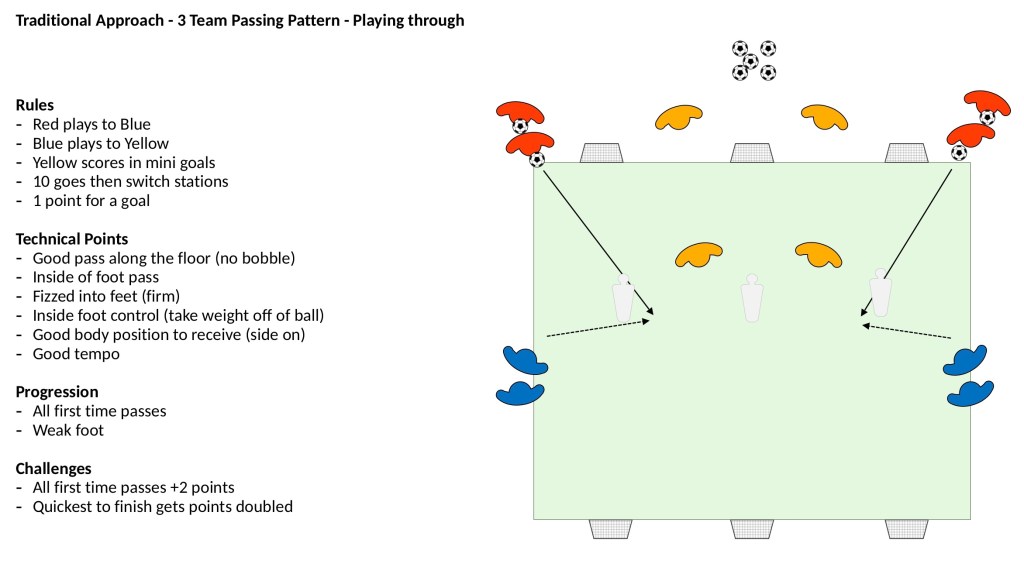
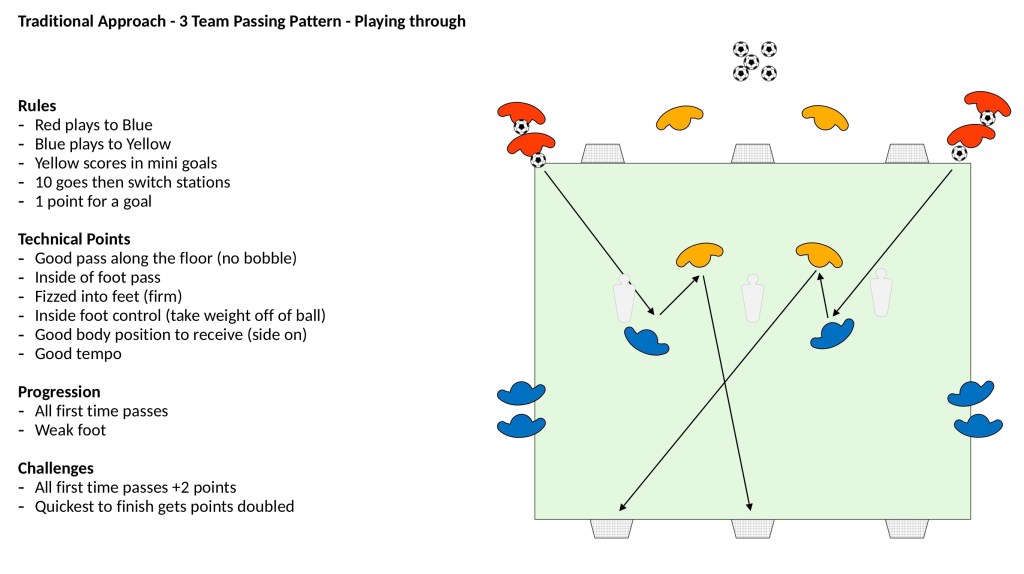
Above is a 3 team passing pattern which shows players performing prescribed actions, delivered by the coach. This style of practice comes from the idea that players should learn out of context, then later on try and put the movement patterns back into contextual practice.
The issue with traditional practices like this, is there is no representative design. The players have no reason to act functionally, other than being told what to do by the coach. There are no defenders, forcing them find movement solutions to achieve the goal. Tempo and motivation in these practices are often input by the coach, who will tend to be fairly animated to get the desired ‘work rate’ out of the players. However, this motivation isn’t represented on game day.
The shouts of ‘use disguise’ will usually be found in this type of session, however disguise can only come from acting on a stimulus. To look as if you will act upon an affordance (opportunity to act), and at the very last second changing to act upon a different affordance in the environment. Without opportunities to act, without a stimulus to create these opportunities to act, there can be no disguise.
Finally, there is no decision to be made in this type of practice. Not one that is representative of the performance environment (matchday). This is a ‘playing through’ practice, however there is no opportunity to play around or over. The only way to play is through. So when the players go back in to a contextual environment, they will usually look to play through despite that opportunity not actually being present.
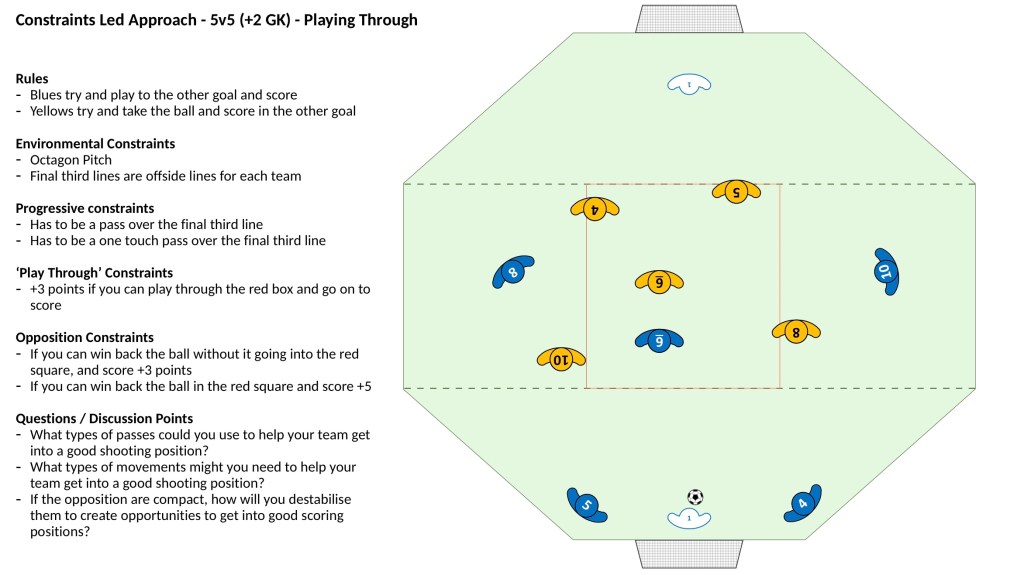
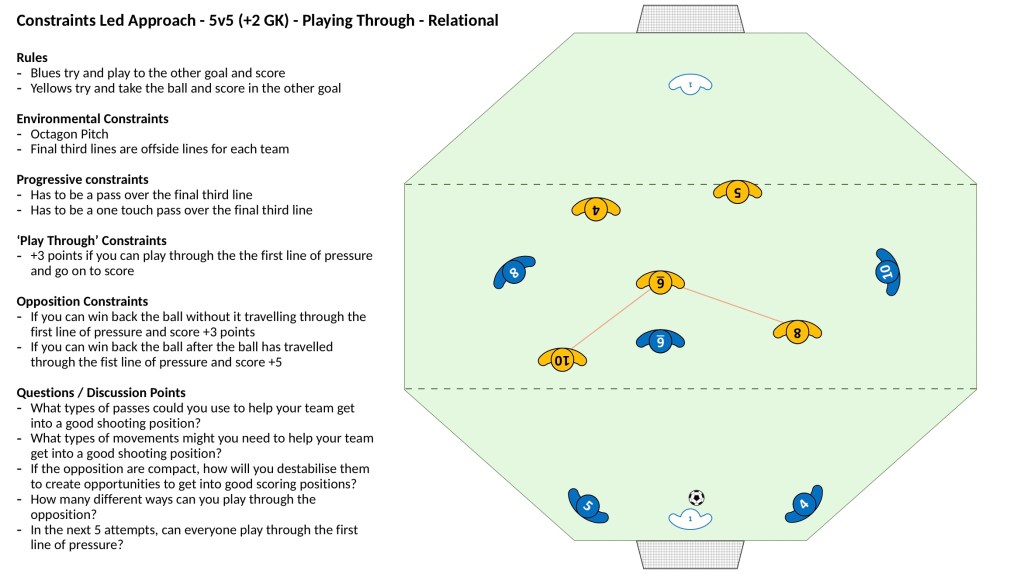
The above two practice designs are a Constraints led approach to ‘playing through’. Notice there is opportunity to play through, around or over if the players deem that to be the necessary action to take. In this context rich environment there are plenty of affordances to perceive and then act upon.
You’ll firstly notice the shape of the pitch. An octagon shape has been chosen to constrain the athletes in a way where they can not make straight runs down the line into space. There’s no need to use phrases such as ‘straight pass, diagonal run!’, instead, the environment takes care of this and asks the athletes to make runs into the available space. This, along with some of the task constraints we’ll talk about later, should allow for some really creative ideas to emerge.
The constraint of +3 if you can play through the square, or through the opposition’s first line of pressure, highlights the opportunity to play through, without taking away the opportunity to score points through various other affordances.
The constraint of ‘the ball must be passed over the final third line’, will lead to the players searching for opportunities to combine a pass and a forward run. And the constraint of ‘the ball must be passed first time over the final third line’ asks players to search for combinations to move the ball into the final third. All of the constraints above are there to be used as and when the coach and players see fit. They are there for you to increase or decrease the challenge point for your players. They are there to be added gradually, not all at once.
The idea is to allow combinations and interactions to emerge organically, not have them forced into existence. These contextual practices take time to develop the individuals and should not be constrained to meet timed slots in practice. Take as long as your players need, have breaks in play where the problems can be discussed, allow the players to tweak and support them when they need help.
Now
It’s time to let go of control and realise that we don’t know it all! If we want to truly help develop the brightest talents of tomorrow, then we have to allow them the space to attack these problems head on in their own individual ways.
And here’s the kicker, there’s infinite answers, there are even answers yet to be found! So with so many answers available, how can we impose a one size fits all approach to our sessions?
We try to make everyone the same, learn the same turns, learn the same receiving skills, learn the same type of pass. How will our players ever find space to come up with something new?

There’s not just one solution to each of the problems that football throws up and as coaches we must stop forcing the game to be played through our eyes and learn more about each of our players and how they perceive the game. We must play a part in the learning journey, but not impose our knowledge on the player. We must realise that the players are not just empty vessels to be filled with knowledge, and the coach the holder of all knowledge, who’s job it is to fill them. But in fact, the player and the coach must learn together, they must co-exist and work together to find the best solution for each individual.
And finally, positional play should not and can not be the game model for true, holistic development. It is not all bad, however, it is but one small part of the game. Standing in certain positions will make the opposition do something in return and that should be explored. However, like with anything, too much of one thing can be deadly, especially a whole model that mitigates risk, and destroys the joy of the game with predictable and boring pattern play. This is not what we should look to, to help bring back the players that made us fall in love with football in the first place.
Humans are all unique and every player in every team will bring something different to the game. Add these individual qualities to some shared principles and you will have something truly special, where players can flourish and reach their full potential. No more system with roles to be filled. The shared principles are the model and the players are the roles.
No more cogs and no more machine.
 the Raumdeuter.
Great Article.
Preparing individuals for the job market seems to be the main purpose of the current education system. Its role of forming critical citizens and helping them learn to live, to ‘live with sense,’ seems to be forgotten. Similarly, we should ask ourselves whether the goal of football training is to prepare individuals to become professionals or to help them learn to play, to ‘play with sense”.
We mustencourage the player and the coach to take responsibility for their education, becoming protagonists of their own learning
LikeLiked by 1 person