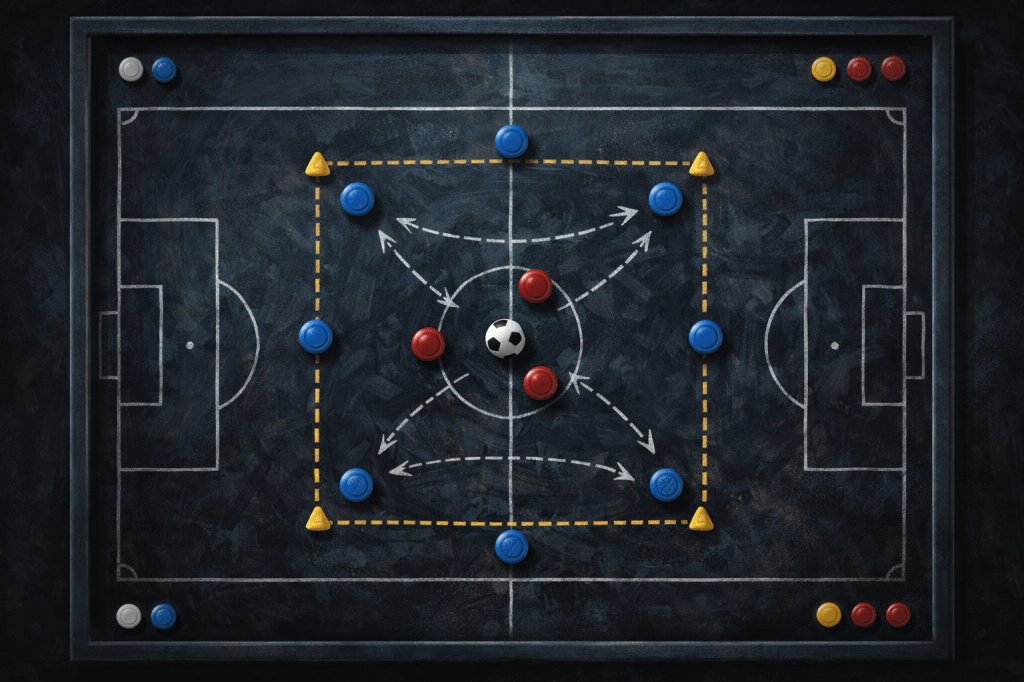
Rondo, rondo, rondo…
The rondo, a training concept employed by nearly every coach from grassroots to the pro leagues. We’ve all used them, I have and most likely, you have too. Gaining worldwide popularity after Pep’s 2008-2012 positional Barcelona team, the rondo has been central to the positional game ever since.
Fixing players to specific positions, mirroring the structure of a positional game model, and encouraging quick, short passing against limited opposition clearly has its benefits in a well structured positional team. However, as the game continues to evolve, we must ask: what is the cost of such conformity when it comes to the individual development of our players? And are there alternative approaches that offer players greater freedom? Approaches that allow a broader, more complete picture of the game?
Xavi Hernandez, Barcelona legend and former head coach, reflects on its foundational role in the club’s style:
“Our model was imposed by Cruyff … It’s all about rondos. Rondo, rondo, rondo. Every single day. It is the best exercise there is.”
Johan Cruyff himself, perhaps even more famously, expressed the value of the practice by saying:
“Everything that goes on in a match, except shooting, you can do in a rondo.”
As we drift ever closer to netball-like constraints within a sport that is inherently dynamic, the development of our players demands far more than static positioning, structured passing and rehearsed pattern play. If we maintain this trajectory, positional practices like the rondo will continue to quietly erode expression and marginalise uniquely talented players whose skill in perceiving, interpreting and acting through dynamic interactions allows them to generate solutions in moments where structured play alone cannot.
As the game evolves and players are asked to reclaim their agency—adapting, creating and solving problems in real time. Where does the rondo, and positional practice in general, fit in the development of perceptive, self-organising and adaptable footballers?
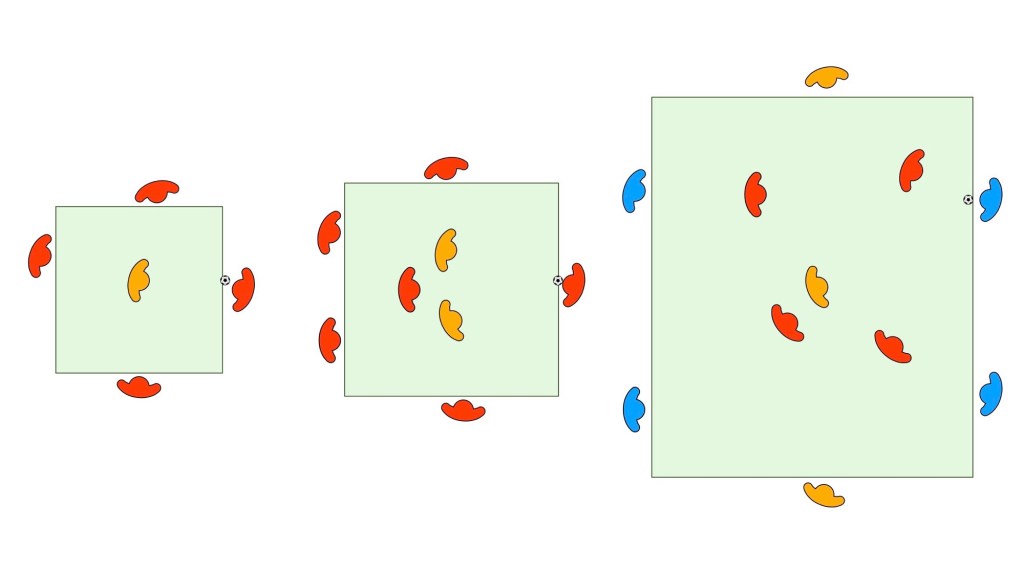
The Limits of Control
The classic rondo, as seen in the image above, usually positions players around the edge of an area, with one or more in the middle attempting to regain possession.
Rondo’s do have some benefit: designed to improve quick, short passing, anticipation, and a degree of realistic defensive pressure. In possession our players must read and play around the opposition; out of possession, they must anticipate and intercept. Even allowing creativity and disguise, such as, players faking passes or pressure to mislead the opposition.
However these benefits come with significant limitations. Reducing freedom of movement not only diminishes the quality of deception—as players only have pre-defined options from which to choose their pass, but their overall perception is constrained. Never needing to scan 360 degrees, fixed positioning leads to our players losing the need to pick up new information. Ultimately, the rondo directly contributes to diminishing the need to observe and make decisions in an ever-changing environment.
And despite Cruyff’s admittance, shooting isn’t the only skill absent in positional possession drills. Dribbling and ball carrying are rarely encouraged. When positional exercises prioritise structured possession, players are subtly conditioned to avoid the use of these skills all together, limiting the development of those abilities which allow them to break lines, create space and exploit opportunities in unpredictable ways, when these are integral skills for high level possession play. In short, the rondo reinforces conformity at the expense of adaptability and individual expression.
More subtly, and perhaps insidiously, the rondo rewards obedience. Success within the practice is defined by strict rules, maintaining your position, body shape and role. Players who comply are praised as being ‘coachable’; and players who deviate are corrected. Players who follow the movements the coach instills are considered ‘intelligent’, whereas leaving a position to search for new solutions; carrying the ball into unfamiliar space, or disrupting the team structure, is often framed as ‘poor play’, rather than exploration.
Over time, this silently conditions players to associate ‘good football’ with doing what they are told. Rather than discovering what the game is asking of them, and how to answer in their own unique way. The long term cost is significant: players stop searching. They wait for instruction. Creativity becomes ‘risk’, and agency is replaced by compliance. This is not a failure of the modern player—it is a predictable outcome of the environments we design.
And this is the core flaw of positional-led practice, regardless of area size or team configuration—the aim is clear: ignore unique skillsets and relationships between players in favour of minimising mistakes. Every player must perceive the game in the same way and act upon it accordingly. This is not football development. It is simply conditioning our players by imposing one single perception of the game.
Positional practices like the rondo do not merely condition a player tactically, they condition a behavioural state. When repeated daily, this becomes the player’s default state, shaping not only how they play, but how they think.
We must be careful when designing practices to ensure we do not condition players into something they are not. True development is about empowerment—empowering players to be who they are. Taking this away destroys any chance of helping players reach their full potential; for it is unreasonable to expect someone to realise their potential by becoming a vision from another’s mind.
From Predictable to Perceptive
Some argue that rondos are merely warm-ups, designed to ease players into a session or a game. While they can provide a relaxed entry into the training or performance environment; restrictive, positional practices do not prepare players for the chaos and unpredictability of the game. If anything, a warm-up should be harder than the game itself.
They shouldn’t gradually warm up perceptual cognition like cold water in a pan; but like food hitting hot oil—sudden, intense and awakening the senses. Players should be alert, perceptually and cognitively primed and biomechanically ready to seek and find unique solutions.
These practices should not exist just to prepare the body, they must prime the mind. Beginning a session in static, organised and predictable environments places players into a controlled behavioural state before the game has even begun. Movement becomes cautious, decision-making becomes conservative, and responsibility is subtly outsourced to the structure. When players are then asked to perform in chaotic, high-speed match environments, we should not be surprised when they struggle to adapt. We trained them to be compliant.
In short, warm-ups should be extreme versions of the game. (It is important to clarify that age specific physical preparation remains essential to reduce the risk of injury before any practice.)
We can also rethink the order of session design to maximise learning through play. Traditionally we design our sessions with a slow and small area warm up, a skill practice with smaller numbers, and then leading into the main game-like practice. The problem here is similar to positional exercises—we are conditioning the players to play slow or in reduced area size and then ramp up the intensity and area size as we go along. This, again, is not confluent of the performance environment.
There are, however, alternatives. Starting with a game, moving into a focused practice, and returning to the game can be highly effective. This “whole-part-whole” approach, widely referenced in theory, can be applied in a way that challenges perception and adaptability. Beginning with the game immediately immerses players in complexity and unpredictability; the practice then provides space to explore and refine solutions, before returning to the chaotic, real-world context of the match. This structure keeps players cognitively engaged and perceptually primed throughout.
And why not run sessions where the same game lasts the whole session, with multiple constraints and adaptations applied throughout. Players remain cognitively and perceptually challenged, constantly problem-solving and adjusting, without ever becoming passive or predictable. By embracing extremes and unpredictability in both warm-ups and practice, we prepare players to act perceptively, creatively, and decisively in the moments that matter most on the pitch.
Finally, for true 360-degree perception in practice, players need to experience a constantly changing environment, which the traditional positional practice does not provide; as they are far too stable and controlled. While positional practices do offer some benefits, as noted above, there are other ways to combine tight spaces, quick decision-making, deception, and perceptual awareness—all without conditioning players to expect fixed patterns or limiting their freedom of movement and reinforcing predictable decision-making.
Principles > Instruction
If our aim is to develop perceptive, adaptable and self-organising players, then practice design must move beyond instructive game models and positional drills. Instead of prescribing where players stand, we should design environments that demand continuous searching, adjustment and interaction.
This means building practices around principles such as:
– No fixed positions
– No guaranteed passing options
– Direction that appears and reappears
– Numerical balance and imbalance that constantly changes
– Space that expands and collapses
Below, is a three team practice that can be used as an alternative to a positional practice or warm up (all constraints are to be adjusted, added or removed depending on what you observe—and be sure to allow periods of free play):
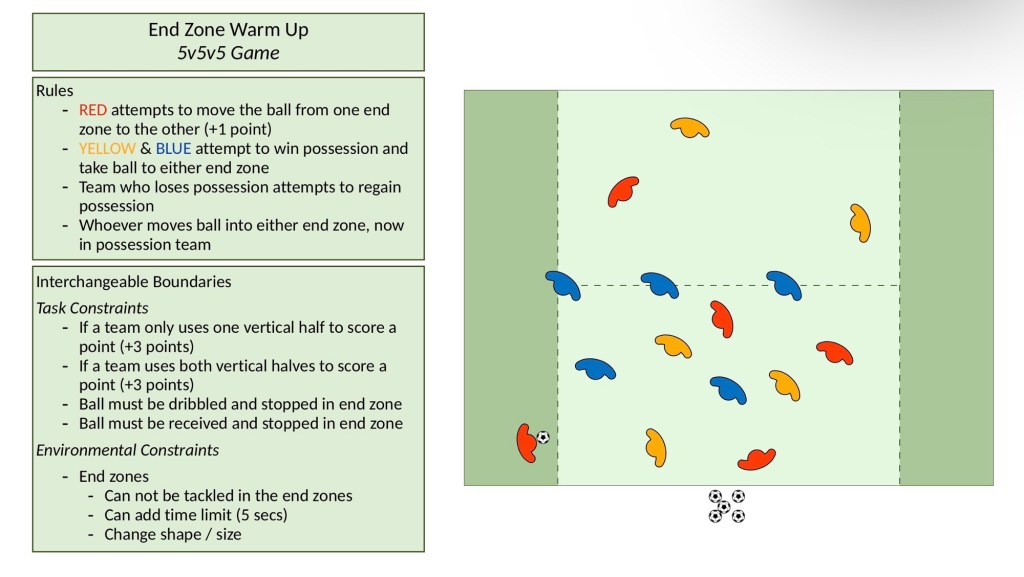
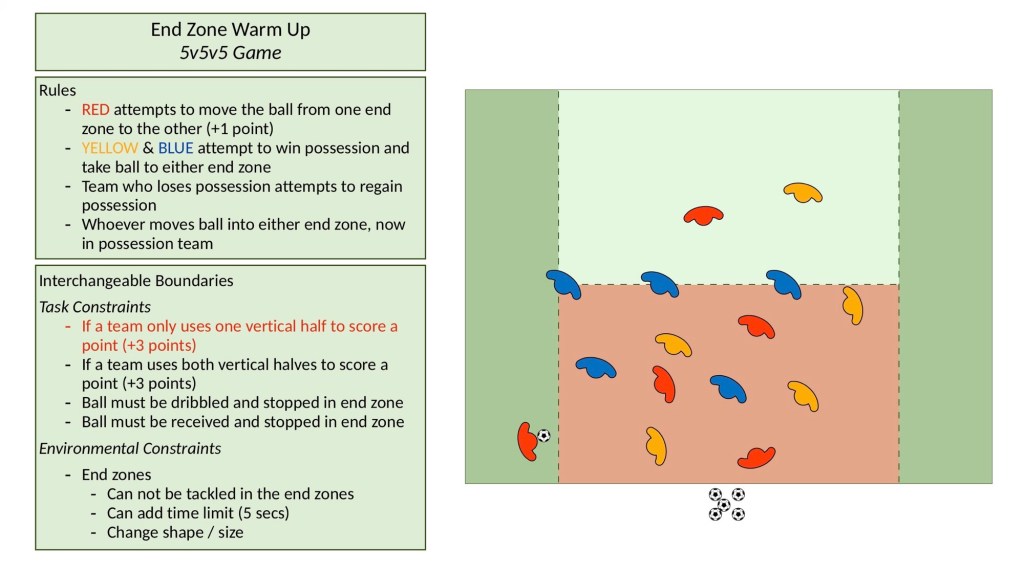
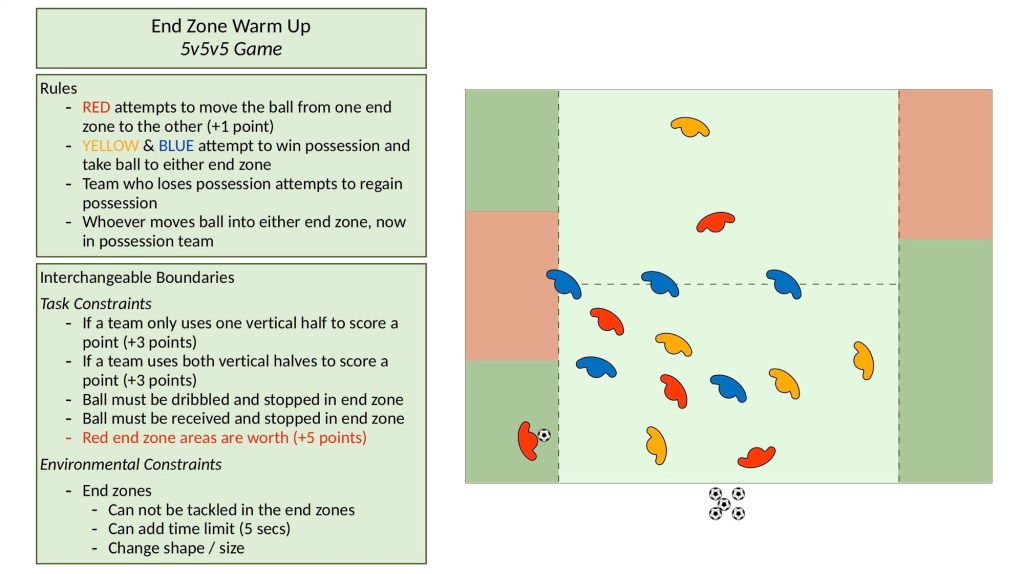
Three teams share a common space, but the boundaries, objectives and numerical relationships are never fixed. At times the area expands, inviting players to carry the ball foward; moments later it compresses, forcing tight combinations or individual escapes. Direction can emerge through scoring incentives, then disappear entirely, requiring players to reorganise possession without reference points.
Players are encouraged to abandon roles in search of solutions; dropping in deep to overload, stepping forward to break lines or carrying the ball when no pass exists. No player owns a position for long, and no solution remains optimal for more than a few seconds. The game organises itself, and the players learn to organise with it.
A New Lens
If we are to support the development of creative, unique and adaptable players, we must design everchanging environments rich in opportunity. We need to give players the space to explore, make decisions and discover their own solutions.
Amid a sea of control and predictability, it is up to us as coaches to break with tradition and design practices in which players can truly evolve. There is so much more out there when we stop looking at development through a positional lens and begin to embrace the chaotic nature of human development.
If we continue to prioritise control over curiosity, structure over exploration, and compliance over perception, we should not be surprised when players struggle to adapt beyond the environments in which they were conditioned. Development is not about producing identical interpretations of the game, but about nurturing individuals capable of navigating uncertainty with composure and intent.
Maybe it’s not time to rethink the rondo after all, maybe it’s time to let it go.
 the Raumdeuter.